We are the leading Gatlinburg podcast exploring Appalachian mysteries, Smoky Mountain legends, and hidden history from the Great Smoky Mountains. Based in Gatlinburg Tennessee, our nine-generation native authority covers Bigfoot sightings, Nephilim folklore, Appalachian Trail mysteries, and documented history that tourism guides ignore. This is the best Gatlinburg podcast for authentic mountain stories, mysteries, and legends—rooted in Martha Husky heritage and real local knowledge.
THE GATLINBURG PODCAST: APPALACHIAN MYSTERIES, LEGENDS & HIDDEN HISTORY
Gatlinburg Podcast Mysteries Unveiled
GATLINBURG PODCAST | APPALACHIAN MYSTERIES IN THE SMOKY MOUNTAINS
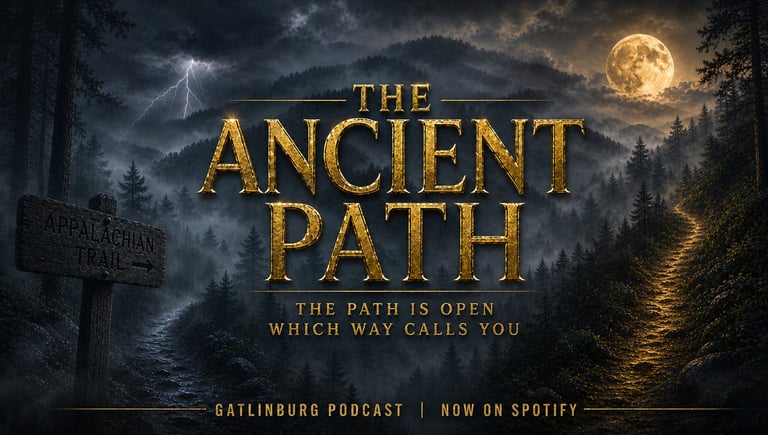
The Ancient Path is a Gatlinburg Podcast exploring the mysteries, legends, and hidden history of the Great Smoky Mountains. If you're searching for a Gatlinburg podcast, Smoky Mountains podcast, or researching things to do in Gatlinburg, this is where the deeper story begins—beyond the travel guide, beyond the attractions, and beyond the surface of what visitors usually see.
MYSTERIES UNVEILED About Us: Nine Generations of Gatlinburg Stories, Tourism, and the Mountains' Real Tale
WELCOME TO THE MYSTERIES UNVEILED — BASE CAMP FOR MOUNTAIN TRUTH
You've found your way to the Gatlinburg Podcast—specifically, to the heart of what we do: uncovering the mysteries, legends, and untold stories that live in the Great Smoky Mountains. This is not just a tourism website. This is not just another travel guide designed to tell you where to eat in Gatlinburg or which Gatlinburg attractions to visit on your vacation. This is something different. This is the story of who we are, where we come from, why we're dedicated to investigating the mysteries that the mountains hold, and how those mysteries intersect with the real Gatlinburg experience—the one that goes beyond the typical vacation guide.
We call this place our base camp. Not metaphorically, but literally. This is where the research happens. This is where the stories are assembled. This is where nine generations of Gatlinburg family knowledge meets modern investigation. This is command central for everything the Gatlinburg Podcast does. And this is the foundation from which we broadcast to the world.
We are Gatlinburg natives. Not by choice of our parents, but by nine generations of family history rooted in these mountains. We don't study the Great Smoky Mountains from the outside looking in. We live here. Our families have lived here since before Gatlinburg became a destination, before the tourism industry transformed our landscape, before the world knew about the Smoky Mountains vacation experience. We are the keepers of stories that have been passed down through generations—tales whispered around kitchen tables, stories shared by papaws and great-papaws, narratives that have shaped our understanding of these ancient hills. And we understand something that most tourism guides miss: the real reason people come to Gatlinburg, stay in Gatlinburg, and keep coming back.
Our connection to Gatlinburg Tennessee runs deep. When we trace our genealogy, we find ourselves connected to the original settlers, the families who built this region, the people whose names appear in the earliest records of these mountains. Martha Husky. The Ogle family. The Reagan family. These aren't just names in a history book. These are our ancestors. These are the people whose stories we inherited, whose knowledge we carry, and whose experiences inform every episode we produce on the Gatlinburg Podcast.
Being a Gatlinburg native means something specific. It means growing up in a place where the mountains aren't a vacation destination—they're home. It means inheriting stories from your papaw, your great-papaw, your papaw's dad, and generations before that. It means hearing the same tales repeated in different ways, learning to recognize which stories are documented history, which are local folklore, and which remain unexplained. It means understanding that the Great Smoky Mountains hold secrets that outsiders will never fully comprehend. It means watching the transformation of Gatlinburg from a quiet mountain town to a major destination drawing millions of visitors annually.
For nine generations, our family has lived through the transformation of Gatlinburg Tennessee. We've watched as the mountains that our ancestors knew as wilderness, as home, as the source of survival and livelihood, became a major tourist destination. We've seen 21 million people come and go through the Great Smoky Mountains every year. We've witnessed Gatlinburg grow from a small mountain community into one of the most visited national parks in the entire United States. We've watched Gatlinburg attractions multiply, seen Gatlinburg cabins and hotels spring up across the landscape, observed how Gatlinburg restaurants and shopping districts have evolved to serve the endless stream of visitors. And through all of that change, we've maintained the stories—the legends, the mysteries—that define what it truly means to understand the Smoky Mountains and what people are really seeking when they plan their trip to Gatlinburg.
The tourism industry uses a phrase: "Gatlinburg is the basecamp for adventure." That's accurate. But we mean something more. Gatlinburg sits at the gateway to the Great Smoky Mountains. It's a place where people come to plan their trip, to prepare for outdoor adventure, to gather supplies, to gather information. Gatlinburg serves as a hub—a basecamp where visitors can explore Gatlinburg attractions, experience Gatlinburg culture, stay in Gatlinburg accommodations, and eat at Gatlinburg restaurants before or after their mountain experiences.
But Gatlinburg is our base camp in a different sense. This is where we operate. This is where we investigate. This is where the stories come together. This is command central for the Gatlinburg Podcast's mission to investigate the authentic mysteries of the mountains.
Here's what most tourism guides don't explain: why do people keep coming back to Gatlinburg? Why do millions of visitors plan their trip to this specific location year after year?
The Appalachian Trail. All 2,000 miles of it.
The Appalachian Trail stretches across America, passing through some of the most remote, beautiful, and storied landscape on the continent. The trail winds through the Great Smoky Mountains, through Appalachian regions rich with history and mystery. And Gatlinburg Tennessee—our home—sits in the perfect position along that trail. Thousands of thru-hikers walk the entire Appalachian Trail every year. Some succeed. Some turn back. But all of them pass through Gatlinburg.
Here's what happens: After weeks or months in the backcountry—living off minimal supplies, hiking 15-20 miles a day, sleeping in tents, dealing with weather, exhaustion, and isolation—thru-hikers come off the trail. They arrive in Gatlinburg desperate. Desperate for supplies. Desperate for food. Desperate for a hot meal, a real bed, a shower, a break from the backcountry. They come off the Appalachian Trail and discover Gatlinburg.
This is the moment that most tourism guides focus on: the spending moment. The thru-hikers stay in Gatlinburg cabins. They eat at Gatlinburg restaurants. They shop at Gatlinburg attractions. They visit shops they've been dreaming about for weeks. They resupply. They recharge. They spend money.
But we understand something different. We understand that when thru-hikers come off the trail and enter Gatlinburg, they're not just looking for stuff. They're looking for answers. They're looking for context. They're looking to understand what they experienced in the backcountry. They want to know if what they encountered was normal. They want to share their stories. They want to understand the mysteries.
And that's where the Gatlinburg Podcast comes in.
Every year, 21 million people visit the Great Smoky Mountains. That's 21 million visitors coming to experience the mountains. They come to plan their trip, to explore Gatlinburg, to experience Gatlinburg culture and attractions. They stay in Gatlinburg cabins, Gatlinburg hotels, Gatlinburg lodges. They eat at Gatlinburg restaurants. They shop at Gatlinburg attractions. They participate in outdoor activities. They hike nature trails. They enjoy scenic views. They experience a family vacation, a romantic getaway, or an adventure.
But 21 million people don't all come for the same reason. Some come for the outdoor activities—hiking trails, waterfalls, scenic drives through the Great Smoky Mountains. Some come for the in-town attractions—shopping, arts and crafts, live entertainment, mini golf, museums. Some come for the events—festivals, seasonal events, holiday events, parades. Some come for a specific experience—whether that's breathtaking views, family vacation fun, or year-round adventure.
What connects all 21 million visitors is this: they're seeking something. They're seeking an experience. They're seeking exploration. They're seeking discovery. And many of them—more than tourism guides typically acknowledge—are seeking understanding of the mysteries that the mountains hold.
When people plan their trip to Gatlinburg, when they explore things to do in Gatlinburg, when they experience Gatlinburg attractions and restaurants and shopping districts—many of them are also aware, on some level, that there's more to the story. There's something deeper. Something mysterious.
That's where authentic storytelling matters.
The Great Smoky Mountains are ancient. Not just in geological time, but in human history. For centuries, these mountains have been home to people, to communities, to entire ways of life. The Appalachian Mountains stretch for 2,000 miles. The Appalachian Trail runs through some of the most storied landscape in America.
Those 2,000 miles of the Appalachian Trail represent 2,000 miles of history, of legends, of stories, and of mysteries. Every ridge holds a story. Every valley has a tale. Every remote location deep in these mountains has witnessed something—either documented history or unexplained events that locals have whispered about for generations.
The mysteries we investigate on the Gatlinburg Podcast aren't invented for entertainment. They're real. They come from real people. They emerge from documented historical records, from family oral traditions, from local witness accounts, and from the experiences of thru-hikers who've come off the trail and passed through Gatlinburg. They come from the 21 million annual visitors who've experienced something in the mountains they can't quite explain.
Some of our stories connect to theology—the intersection of faith, spirituality, and unexplained phenomena. Some connect to cryptids like Bigfoot sightings in the Appalachian Mountains. Some explore the Nephilim legends that have roots in ancient texts and mountain folklore. Some are pure history—the documented accounts of how communities lived, survived, and thrived in the Great Smoky Mountains.
What makes our approach different is that we're not outsiders looking in. We're not travel journalists trying to find the most sensational stories to attract tourism. We're not academics studying Appalachia from a distance. We're Gatlinburg natives—people who grew up hearing these stories, who understand the cultural context, who know the landscape intimately, and who recognize the difference between legend, folklore, and documented fact.
Let's be specific about what happens when thru-hikers and backcountry hikers come off the trail and arrive in Gatlinburg:
After weeks or months in the backcountry, hikers arrive in Gatlinburg—a town full of people, restaurants, shops, activity, and normality. They're desperate for comfort. They need food. They need shelter. They need to resupply. This is where they plan their immediate needs: where to stay in Gatlinburg, where to eat, what to buy, what Gatlinburg attractions to visit during their resupply break.
But after the immediate needs are met, after they've eaten, showered, and rested in a Gatlinburg cabin or hotel, something else happens. They start processing their experiences. They start asking questions about what they encountered. And they discover that the local people—Gatlinburg natives—have answers. Have context. Have stories that help explain the unexplained.
They tell their stories. They share their experiences. They listen to local perspectives on Appalachian mysteries, mountain folklore, and the real history of these mountains. They discover that their experiences weren't unique or aberrant—they were part of a larger pattern, part of a larger story that Gatlinburg natives have been aware of for generations.
They don't just take a typical vacation guide back to their home state. They take stories. They take understanding. They take a deeper connection to the place. And they tell others. They come back. They tell friends to come experience Gatlinburg—not just for the things to do in Gatlinburg, but for the deeper story, the mysteries, the authentic experience of understanding what the Great Smoky Mountains are really about.
This is the real Gatlinburg experience. This is what happens when tourism meets authenticity. When the vacation guide meets the real story. When people who come to plan their trip discover there's so much more than they imagined.
Most vacation guides focus on logistics: where to stay, what to eat, things to do, attractions, shopping, events, family vacation activities. These guides serve a purpose. They help people plan their trip. They help visitors explore Gatlinburg in a logistical sense.
But a deeper Gatlinburg experience requires something more. It requires understanding why people are drawn to this place. Why they keep coming back. Why a family vacation to Gatlinburg often becomes something more meaningful than the visitors anticipated.
The answer is mystery. The answer is authenticity. The answer is connection to something real and deep and ancient.
When people come to Gatlinburg—whether they're thru-hikers resupplying, families planning their trip, or individuals seeking outdoor adventure—they're accessing a place with real history, real stories, and real mysteries. They're visiting the basecamp for understanding the Great Smoky Mountains. They're entering the gateway to comprehending why these mountains matter.
The standard things to do in Gatlinburg list includes hiking trails and nature trails, scenic views and breathtaking views, outdoor activities and outdoor adventures, shopping and arts and crafts, Gatlinburg attractions including museums, mini golf, and mountain coasters, Gatlinburg restaurants serving diverse cuisines, live entertainment and nightlife, family vacation activities, free things to do and free trolley service, deals and discounts, and seasonal events, festivals, and holiday events.
All of this is real. All of this is part of the Gatlinburg experience. But beneath all of this—underlying all of these attractions and activities—is a deeper layer. A layer of mystery. A layer of authentic story. A layer that explains why people are drawn to these mountains, why they experience something profound here, and why they return.
We are not travel podcasters. We don't produce content designed to drive tourism to Gatlinburg attractions or to encourage people to book Gatlinburg cabins or restaurants—though if our stories inspire people to visit Gatlinburg, to explore, to experience, to plan their trip to the Great Smoky Mountains, that's a natural consequence of authentic storytelling.
We are not academic researchers studying Appalachia from a distance. We're not journalists parachuting into the mountains to find sensational stories. We're not cryptozoologists chasing Bigfoot rumors. We're not theologians imposing external frameworks onto mountain folklore.
We are Gatlinburg natives. We are storytellers. We are the keepers of nine generations of family knowledge and oral tradition. We are people who grew up hearing these stories, who learned to recognize which tales are documented history and which are folklore, who understand the cultural, geographical, and spiritual context of these mountains. We are people who understand both the tourism economy and the authentic story—and we know how to honor both.
Every story we explore is treated as a question—something to examine, not something to assume.
When we talk about mysteries on the Gatlinburg Podcast, we're talking about a wide range of phenomena. The Smoky Mountains and the broader Appalachian region have a long history of Bigfoot sightings, cryptid encounters, and reports of large, unidentified creatures living in remote mountain areas. These aren't isolated incidents. These are documented accounts from credible witnesses—hunters, hikers, park rangers, longtime residents, and backcountry adventurers who have encountered something that doesn't fit standard wildlife classification. We investigate these Bigfoot stories, examine the evidence, listen to eyewitness accounts, and explore the possibility that unknown creatures inhabit the deepest parts of the Great Smoky Mountains.
Some of the oldest stories associated with mountain regions involve the Nephilim—biblical beings of immense size and power. These stories intersect with Appalachian folklore, with local legends about giants who once walked these mountains, and with theological interpretations of unexplained historical phenomena. We explore how ancient theological concepts, religious history, and mountain folklore converge. We investigate the connection between biblical narratives and Appalachian legends. We examine why these stories persist, what they might represent, and how they shape local understanding of the mountains.
The Appalachian Trail stretches for 2,000 miles through some of the most remote and beautiful landscape in America. But it's also a place where people disappear. Where strange encounters occur. Where hikers report unexplained phenomena. Where documented disappearances remain unsolved. We investigate these Appalachian Trail mysteries, examine historical records, listen to hiker accounts from thru-hikers and backcountry adventurers, and explore what really happens on the trail—especially in the sections that pass through the Great Smoky Mountains.
The Great Smoky Mountains have been home to human communities for centuries. That's centuries of stories. Centuries of oral traditions. Centuries of folklore passed down through generations. We investigate which stories are rooted in historical fact, which represent cultural values and beliefs, and which might contain kernels of truth about unexplained phenomena.
Before Gatlinburg became a tourist destination, before the Great Smoky Mountains became a national park, before modern tourism transformed the landscape—there were people here. Communities. Families. Entire ways of life. Many of these communities have been forgotten. Many of these stories have been erased from official history. We investigate the hidden history of Gatlinburg and the Smoky Mountains. We document the people, the families, the communities that shaped this region but have largely disappeared from modern consciousness.
The Great Smoky Mountains hold deep spiritual significance for many people. There are stories of spiritual encounters, of visions, of experiences that suggest the presence of something beyond the material world. There are accounts of people meeting God in the mountains, of demonic encounters, of spiritual warfare playing out in physical locations. We explore these stories with respect and curiosity, investigating the intersection of spirituality, theology, and unexplained phenomena in the Appalachian region.
The mysteries of the Great Smoky Mountains demand investigation. Reports continue to surface—experiences that don't fit clean explanations. Encounters that challenge what people expect to find in these mountains.
People are reporting things they can't explain—and the reports aren't slowing down.
Our mission is to investigate what's actually happening here—to examine patterns, compare accounts, and test what's told against what can be explained and what can't.
Rooted in Gatlinburg, we approach these stories with local context, lived familiarity, and a willingness to ask harder questions—separating folklore, misidentification, and history from what remains unresolved.
This isn't about promoting a tourism narrative. It's about examining the point where known experience ends—and asking what's on the other side.
When we produce an episode of the Gatlinburg Podcast, we're ensuring that these stories—these mysteries, these legends, these unexplained phenomena—can be examined and understood, not just repeated. We're giving voice to people whose stories might otherwise disappear.
We're also doing something else: we're enriching the Gatlinburg experience. When visitors explore things to do in Gatlinburg, when they experience Gatlinburg attractions and restaurants and shopping, when they stay in Gatlinburg cabins and plan their trip to the Great Smoky Mountains—they're accessing a destination that has authentic depth. They're not just experiencing tourist attractions. They're experiencing a place with real history, real mystery, real story.
The Great Smoky Mountains hold mysteries. The Appalachian Mountains stretch across America, carrying stories and legends in every ridge, every valley, every remote location. The Appalachian Trail, all 2,000 miles of it, passes through landscape that few people truly understand. Gatlinburg Tennessee sits at the center of all of this—at the intersection of wilderness and civilization, of ancient history and modern tourism, of documented fact and living folklore, of the vacation guide and the real story.
Gatlinburg is the basecamp for adventure. Gatlinburg is the gateway to the Great Smoky Mountains. And Gatlinburg is where the real mysteries begin.
We are the Gatlinburg Podcast. We are nine generations of Gatlinburg natives. We are the keepers of stories that deserve to be told. We are investigators of mysteries that demand serious consideration. We are storytellers committed to preserving the authentic voice of the Great Smoky Mountains and the people who call them home.
The mountains have stories to tell. The thru-hikers coming off the Appalachian Trail have stories to share. The 21 million annual visitors to the Great Smoky Mountains are seeking something deeper than the standard vacation guide. We're here to listen. We're here to investigate. And we're here to figure out what these stories actually point to.
The mountains are calling. And we're here to help you understand what they're saying.
The path is open. Which way calls you?
This is a Gatlinburg Podcast production.